The three-part model
Core Intelligence, spirit body, physical body — a nested hierarchy explained through Huxley's reducing valve, higher-dimensional physics, and a Matryoshka doll.
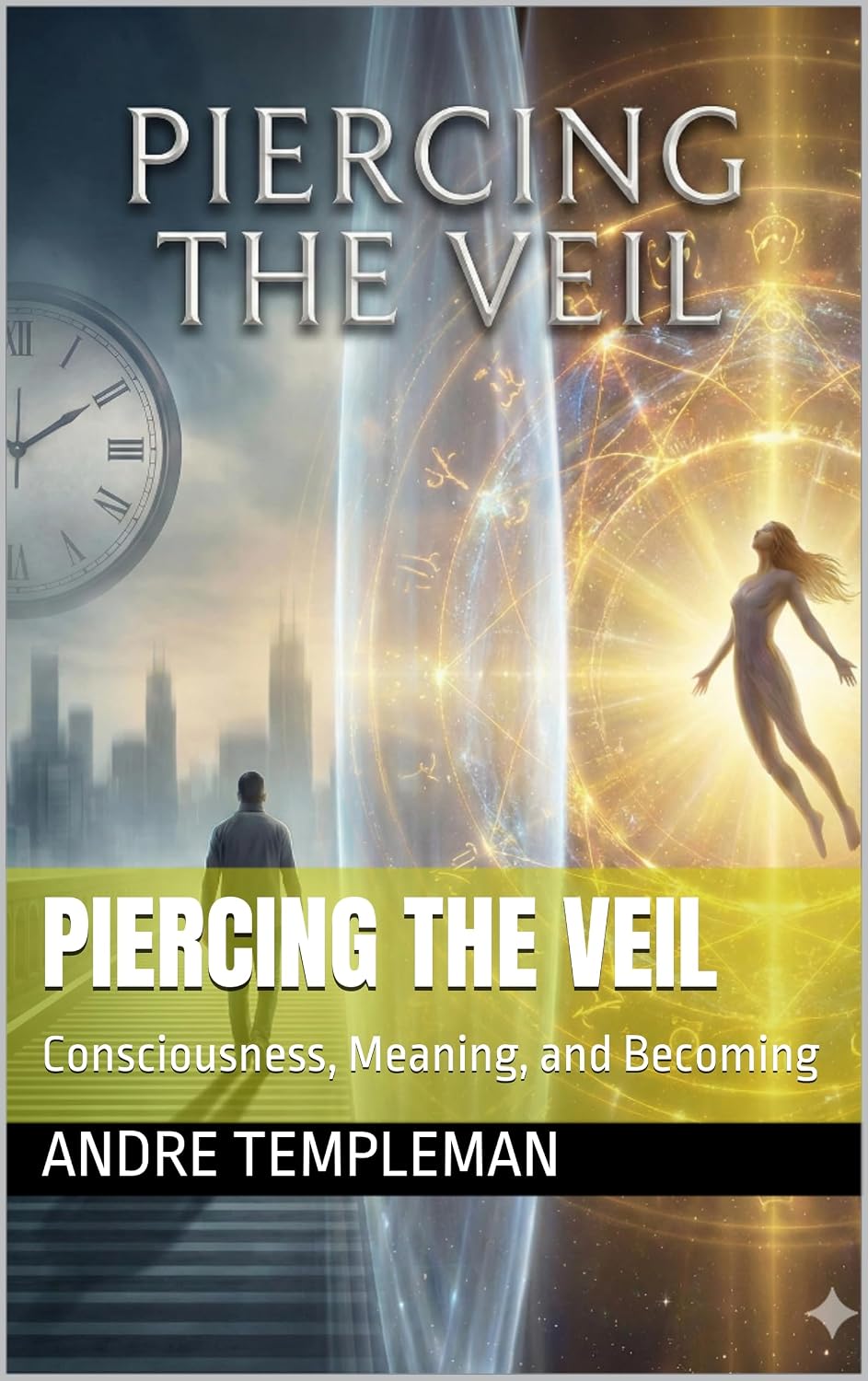
A book by Andre Templeman
Consciousness, Meaning, and Becoming
Everything you perceive passes through a filter. But what if that filter is not a wall — what if it is a teacher?
The argument
Human perception is deliberately narrowed — by the brain's gating, by the Default Mode Network, by evolution's preference for fitness over truth. Piercing the Veil argues that this narrowing is what makes choice, learning and coherent action possible in the first place.
Beneath the filter, the book proposes a three-part model of a person: an eternal Core Intelligence that observes, a Spirit or informational body that translates, and a physical body that learns under constraint. The veil between them can be thinned — lawfully, gradually, through breath, physiology, attention, relationship and ethics. But piercing it without preparation fragments rather than liberates.
“Seen clearly, the Veil is not an enemy. It is a teacher.” Chapter 2
The payoff is not enlightenment. It is formation.
What's inside
Core Intelligence, spirit body, physical body — a nested hierarchy explained through Huxley's reducing valve, higher-dimensional physics, and a Matryoshka doll.
Breath as the bridge between voluntary and involuntary. Meditation as physiological retraining rather than a mental trick.
Nutrition, fasting, inflammation and circadian rhythm set the noise floor. Overstimulation and "loop capture" thicken the veil.
Relationship, marriage, family and community as the primary arena of growth — where the veil is thinnest.
Grief, divorce, collapse and depression mapped honestly — as passages that can thin the veil or thicken it.
Relativity, the block universe, dreams and Aboriginal "Everywhen" — why depth of presence beats duration.
Practice
The book ships with appendices, not just arguments — each with numbered steps, illustrations and explicit contraindications:
Foundational (10–30 min/day, stability first) · Integrative (30–60 min/day, monthly mini-retreats) · Immersive (multi-day retreat, requires guidance). The book is explicit that these are three modes of showing up, not a hierarchy of seekers.
“The goal is not intensity. It is continuity. Show up. Keep showing up. That's the whole secret.” Chapter 12
Honest about its limits
In a genre defined by overpromise, Piercing the Veil includes a dedicated section titled When NOT to Use This Book — naming active psychosis, mania, severe dissociation, acute suicidal ideation, untreated eating disorders, the first six months of trauma recovery, and active substance use. It carries crisis resources and a 988 referral.
It also teaches readers to fact-check the author. An entire appendix — How to Evaluate Science-Spirituality Claims — exists for that purpose. Where the science is speculative, the book says so plainly.
“Therapy does not replace spiritual inquiry. It makes it viable.” Chapter 11
Who it's for
The book names its reader directly in Chapter 6: “Many of you who are reading this book right now are not here out of curiosity. You are here because you are hurting.”
“This book does not ask you to believe. It asks you to practice.” Chapter 16
The author
Andre Templeman was born and raised in Guelph, Canada, in a Mormon home, the son of a Canadian diplomat — which meant moving almost every two years, on schedule, and always being the new kid. He loved both scripture and physics, and could never accept that he had to choose. That refusal is the seed of this book.
He has been married and divorced. He is the father of a daughter, Maia, to whom the book is dedicated, and whose question — why was he staring at his phone? — opens it. He writes about panic attacks, about pushing people away, about losing evenings to an algorithm. It is not a guru's voice.
“I invite you to read it the same way: as one map among many, drawn by a fellow traveler who is still finding his way.”
Piercing the Veil is his first book. His second, Will AI Take My Job?, publishes in 2026. He is also the founder of Alpha Inception.